
National Listening and Solutions Tour: Sacramento Summit Recap
The Coalition to Empower our Future (CEF) recently hosted a summit in Sacramento featuring a diverse group of panelists, including experts, former lawmakers, community program leaders and youth voices, to discuss the complex factors driving youth mental health challenges and the comprehensive solutions needed to solve them. The panelists focused on the complexity and individuality of the youth mental health challenge, the importance of building on programs that are making a true difference and how certain one-size-fits-all solutions miss the mark on addressing the totality of youth wellbeing.
The event was the latest in CEF’s listening and solutions tour, aimed at fostering conversations about identifying meaningful, holistic, long-lasting solutions to the complex challenges today’s young people face. Previous convenings were held in Albany, NY and Miami, FL.
Glen Weiner, executive director of CEF, opened the Sacramento event with a fireside chat featuring Steve Bullock, former governor of Montana and CEF board member, and Darrell Steinberg, former mayor of Sacramento and founder of the Steinberg Institute. The group discussed the overarching challenges facing young people today and how imperative it is for adults to work together to make a positive impact on young people to support their wellbeing.
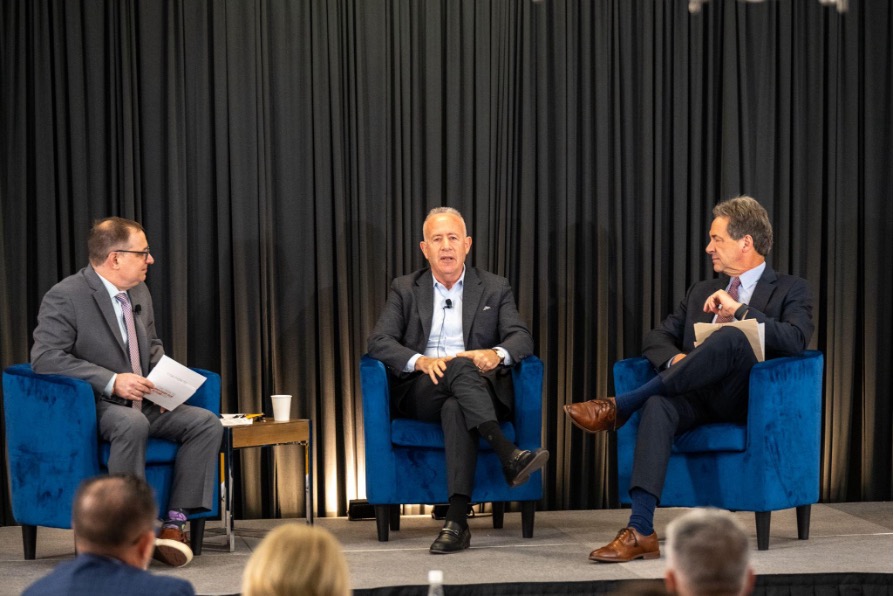
Former Mayor Steinberg speaking on his journey into mental health advocacy across years of experience in the California Senate.
Bullock noted that “it’s a complex issue … it’s so easy in public office to just get mired in statistics, but behind every statistic are individual children and individual families, and if we address it that way, I think we’re going to get much further along the path.” Steinberg added to the discussion by stating, “Something that I’ve come to learn when it comes to young people … is that it’s not just about services. It’s about friendship, it’s about support, it’s about the environment. The best youth mental health counselor is a peer and a friend.”
Next was a panel discussion focused on “Naming the Challenge,” featuring a mix of mental health advocates and youth leaders, including:
- Celeste Walley, youth advocate and permanency and youth engagement advisor for the California Alliance of Child and Family Services
- Jevon Wilkes, executive director of the California Coalition for Youth
- Lishaun Francis, senior director of Behavioral Health for Children Now
- Peter McGinnes, youth advocate and council member for the Coalition for Student Wellbeing
- Roman Musso, youth advocate and founder of Path to Positivity
Panelists touched on the wide variety of factors affecting youth mental health today, through the lens of those working with children each day and the personal experiences of young people themselves. Musso and McGinnes, two college students involved in advocacy and peer support for youth mental health, reflected on their own experiences with mental health challenges, providing unique insight into the various complex issues young people face and highlighting solutions that they believe would support overall youth wellbeing. McGinnes emphasized the complexity of the issue, noting that “I think the whole point of this talk today is recognizing that it is such a complex issue … if we realize that this issue is just so complicated, so multifaceted, how do we find one solution that fits everything? It’s impossible.”
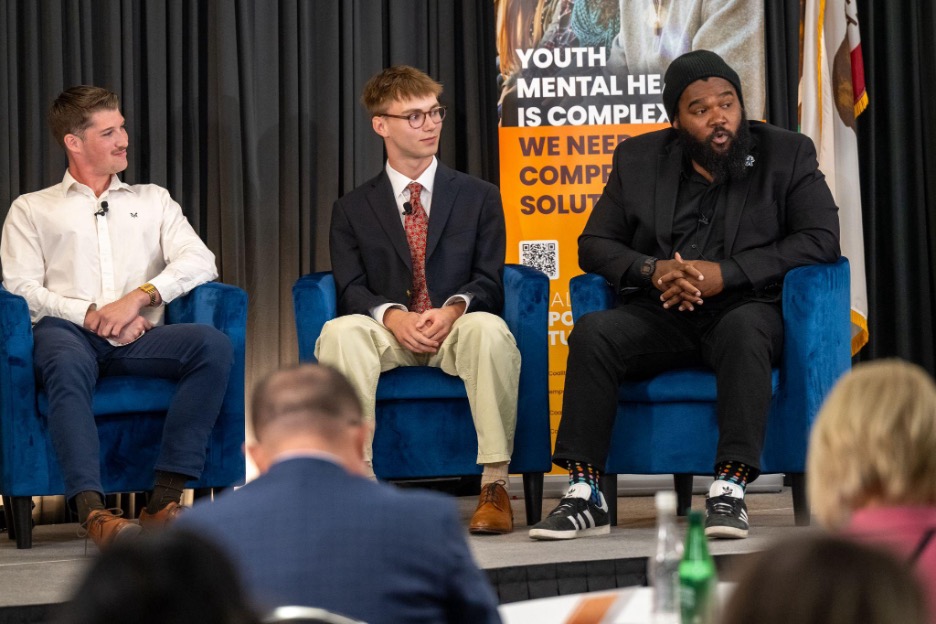
Roman Musso and Peter McGinnes listen in as Jevon Wilkes details the hardships that young people face in government programs.
Walley spoke on systematic approaches in foster care and the role institutions play in solving this challenge, reflecting on her own experiences in the foster care system, noting her optimism on recent headway on the issue, explaining, “I’m optimistically saying that I think we’re moving more towards a point where that kind of holistic [approach of] how you have healed overall, how you have reconnected to your sense of self to community, has become a priority.” Wilkes and Francis offered their perspective on the importance of mentorship in youth wellbeing, emphasizing the impact that mentors and peer relationships can have on young people to feel comfortable and welcomed, as well as the need to purposefully listen to and involve young people in the conversations about their mental health.
Finally, the event turned to the “Identifying the Solutions” panel, which brought together mental health experts and community program leaders with years of hands-on experience in addressing youth mental health challenges. Speakers included:
- Karen Larsen, chief executive officer of the Steinberg Institute
- Kristina Halmai-Gillan, director of service innovation for YMCA of San Diego County
- Marlon Morgan, chief executive officer of Wellness Together
Experts emphasized how a comprehensive approach to this challenge requires hard work from all of us, and that looking at solutions in a holistic way instead of implementing one-size-fits-all solutions will avoid leaving kids behind. Halmai-Gillan noted the importance of engaging activities that foster relationships between kids and their peers, saying, “When we can focus on connecting kids, there is so much healing and protection within that. Therapists are important, and there are young people and adults who need therapy, but therapy alone is not going to do this.” Morgan expressed optimism that the panel’s discussion was an important step in the right direction, noting that “I think the fact that we’re all coming together right now and listening to each other, talking to each other, the medium is the message. This is the message. This is what we need to be doing, and we’re doing it.”
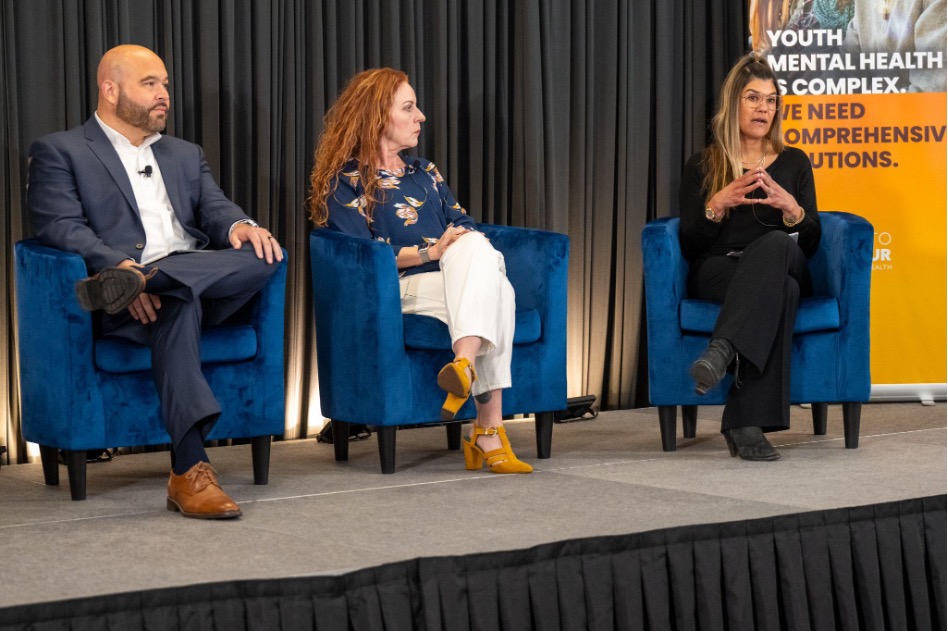
Kristina Halmai-Gillan explains the importance of engaging activities for youth wellbeing.
All three important panel discussions made clear that the youth mental health challenge is complex, multifaceted and requires an approach that looks at this challenge from all angles in order to find appropriate solutions. The panel featuring young people with direct experience with mental health challenges highlighted the importance of including youth in solution-driven discussions, while the expert panel emphasized how crucial it is to foster community support, relationship building and other peer-focused approaches that enhance youth wellbeing.
The summit was rounded off by highlighting the many diverse perspectives raised during the panels. A narrow approach to addressing youth mental health and wellbeing overlooks the individuality of those experiencing these challenges. That’s why it’s important to work together, as schools, community organizations, families and everyone who plays a role in youth wellbeing. This collective effort is essential to support and empower young people.
###